Quick Answer
HIPAA-compliant texting software is a platform that encrypts patient messages, requires a signed Business Associate Agreement, enforces access controls, and maintains audit logs so texting protected health information is legal. Standard SMS is unencrypted, so texting PHI on it is a federal HIPAA violation, which is why healthcare practices must use a BAA-backed, encrypted platform that lives inside their owned CRM.
Key Takeaways
- No.
- A signed Business Associate Agreement, end-to-end encryption, role-based access controls, automatic message expiration, and audit logs that record who accessed what and when.
- Yes.
- Yes, on a compliant platform with two-way encrypted messaging.
- Some all-in-one CRMs offer a HIPAA-compliant texting module with a signed BAA for about $48 to $97 per month, cheaper and more integrated than a standalone secure-messaging app that splits your patient data.
Definition
Standard SMS is unencrypted and texting PHI on it is a federal HIPAA violation.
HIPAA-compliant texting software is a platform that encrypts patient messages, requires a signed Business Associate Agreement, enforces access controls, and maintains audit logs so texting protected health information is legal. Standard SMS is unencrypted, so texting PHI on it is a federal HIPAA violation, which is why healthcare practices must use a BAA-backed, encrypted platform that lives inside their owned CRM.
Why standard SMS is a HIPAA violation
Standard SMS is unencrypted, passes through carrier servers, and can be intercepted, which is why texting protected health information over it is a federal HIPAA violation. Healthcare practices must use a BAA-backed, encrypted platform, or they risk fines and exposed patient data.
The most common HIPAA violation in a dental or med-spa practice is also the most routine: a front desk worker texting a patient's appointment details, name, and treatment over standard SMS. Standard SMS is unencrypted, stored on carrier servers outside the practice's control, and readable in transit. Texting PHI over it is a federal violation unless the patient has specifically authorized that disclosure, and even then the practice has no audit trail. The fix is a compliant platform, and the same logic applies to the broader healthcare CRM stack in our HIPAA-compliant CRM for healthcare guide.
The four requirements of compliant texting
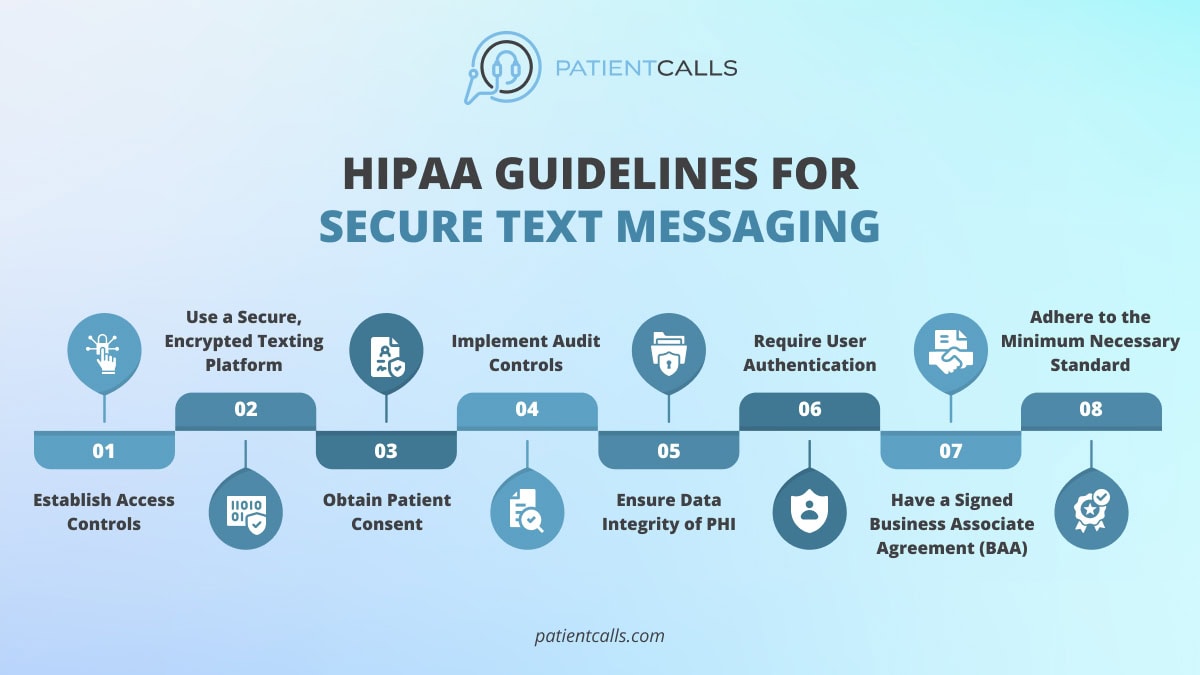
A HIPAA-compliant texting platform requires a signed Business Associate Agreement, end-to-end encryption, role-based access controls, and audit logs. Miss any one and the platform cannot legally carry protected health information.
| Requirement | What it does | Why it matters |
|---|---|---|
| Signed BAA | A contract making the vendor a HIPAA Business Associate | Legally required for any vendor handling PHI |
| Encryption | End-to-end encryption of messages in transit and at rest | Prevents interception and unauthorized reading |
| Access controls | Role-based access so only authorized staff see PHI | Limits exposure to the minimum necessary |
| Audit logs | Records of who accessed what message and when | Required for breach investigation and compliance proof |
What you can and cannot text
On a compliant platform you can text appointment details, treatment reminders, and intake links that carry PHI, because the platform encrypts and logs it. On standard SMS you can only text non-PHI messages like 'you have an appointment, call us back,' never the patient's name with treatment details.
- Compliant: appointment reminders with patient name and treatment details on an encrypted platform.
- Compliant: secure intake links and forms that collect PHI through encrypted channels.
- Compliant: two-way replies that encrypt and log the patient's messages to their record.
- Non-compliant: any PHI over standard SMS, including name plus appointment type.
- Non-compliant: screenshots of patient records sent via standard messaging apps.
Building the compliant texting flow is engineering work, which is why an expert AI automation engineer configures the BAA-backed platform, encryption, access roles, and audit logging so patient messaging is both legal and automated. The dental application is in our missed-call text-back for dentists guide, and the med-spa application in med spa no-show reduction.
Choosing compliant texting software
Choose a platform that signs a BAA, encrypts end-to-end, enforces role-based access, and maintains audit logs, and that lives inside your CRM so patient messages sync to the record. Avoid any tool that cannot produce a signed BAA, no matter how convenient.
- 1Confirm the vendor signs a Business Associate Agreement before texting any PHI.
- 2Verify end-to-end encryption of messages in transit and at rest.
- 3Check role-based access controls so only authorized staff can view PHI.
- 4Ensure audit logs record access for compliance and breach investigation.
- 5Confirm CRM integration so messages sync to the patient record automatically.
When you want compliant patient texting wired into your owned CRM with the BAA and encryption handled, book a free setup audit and we will map it to your practice.
This is one piece of the owned marketing engine model, where each rented tool, from the secure-messaging platform to the CRM to the audit logs, is rebuilt as part of one owned system for a single one-time build fee.
Key takeaways
- Standard SMS is unencrypted and texting PHI over it is a federal HIPAA violation.
- Compliant texting requires a signed BAA, encryption, access controls, and audit logs.
- An estimated 75% of providers are expected to adopt secure messaging by 2026.
- On a compliant platform you can text appointment and treatment details; on SMS you cannot.
- Choose compliant texting inside your CRM, not a standalone app that splits patient data.

Marjohn Robillo— AI Automation Engineer & Lead AI Consultant
Marjohn Robillo is the AI Automation Engineer and Lead AI Consultant at Apehx Digital, architecting speed-to-lead, conversational text-back, and AI-qualification systems for US service businesses. Portfolio & consulting: marjohnrobillo.me.
See more of Marjohn's workFrequently Asked Questions
Is standard SMS HIPAA compliant?
No. Standard SMS is unencrypted, can be intercepted, and is stored on carrier servers outside your control. Texting protected health information over standard SMS is a federal HIPAA violation unless the patient has specifically authorized it.
What makes texting software HIPAA compliant?
A signed Business Associate Agreement, end-to-end encryption, role-based access controls, automatic message expiration, and audit logs that record who accessed what and when. All are required for texting PHI legally.
Do I need a BAA for texting software?
Yes. A Business Associate Agreement is mandatory under HIPAA for any vendor that handles PHI, including a texting platform. Without a signed BAA, using the platform for patient messages is a violation, even if it is encrypted.
Can a patient reply to HIPAA-compliant texts?
Yes, on a compliant platform with two-way encrypted messaging. The patient's replies are encrypted and logged to their record, unlike standard SMS where replies sit unencrypted on the carrier network.
Is HIPAA-compliant texting included in a CRM?
Some all-in-one CRMs offer a HIPAA-compliant texting module with a signed BAA for about $48 to $97 per month, cheaper and more integrated than a standalone secure-messaging app that splits your patient data.
More from the blog
Related guides in the same topic cluster.