Quick Answer
Lead response time is the elapsed time between a lead's inquiry and the first response. A lead contacted within 5 minutes is up to 100 times more likely to convert than one contacted after 10 minutes, yet the average business takes 47 hours to respond. The 5-minute rule is the single cheapest conversion lever available, and it is automatable with instant text-back and AI qualification.
Key Takeaways
- The 5-minute rule states that a lead contacted within 5 minutes of their inquiry is up to 100 times more likely to convert than one contacted after 10 minutes.
- The average business takes 47 hours to respond to a new lead, which is why most leads go cold and convert with whoever responds first.
- Because the lead's buying intent peaks at the moment of inquiry and decays fast.
- With automated instant text-back that fires the moment a lead form is submitted or a call is missed, engaging the lead in under 15 seconds while a human prepares to follow up.
- Most for high-intent service businesses like contractors, dental, and med spa, where the lead is actively comparing and books with whoever responds first.
Definition
The 5-minute rule states that a lead contacted within 5 minutes of their inquiry is up to 100 times more likely to convert than one contacted after 10 minutes.
Lead response time is the elapsed time between a lead's inquiry and the first response. A lead contacted within 5 minutes is up to 100 times more likely to convert than one contacted after 10 minutes, yet the average business takes 47 hours to respond. The 5-minute rule is the single cheapest conversion lever available, and it is automatable with instant text-back and AI qualification.
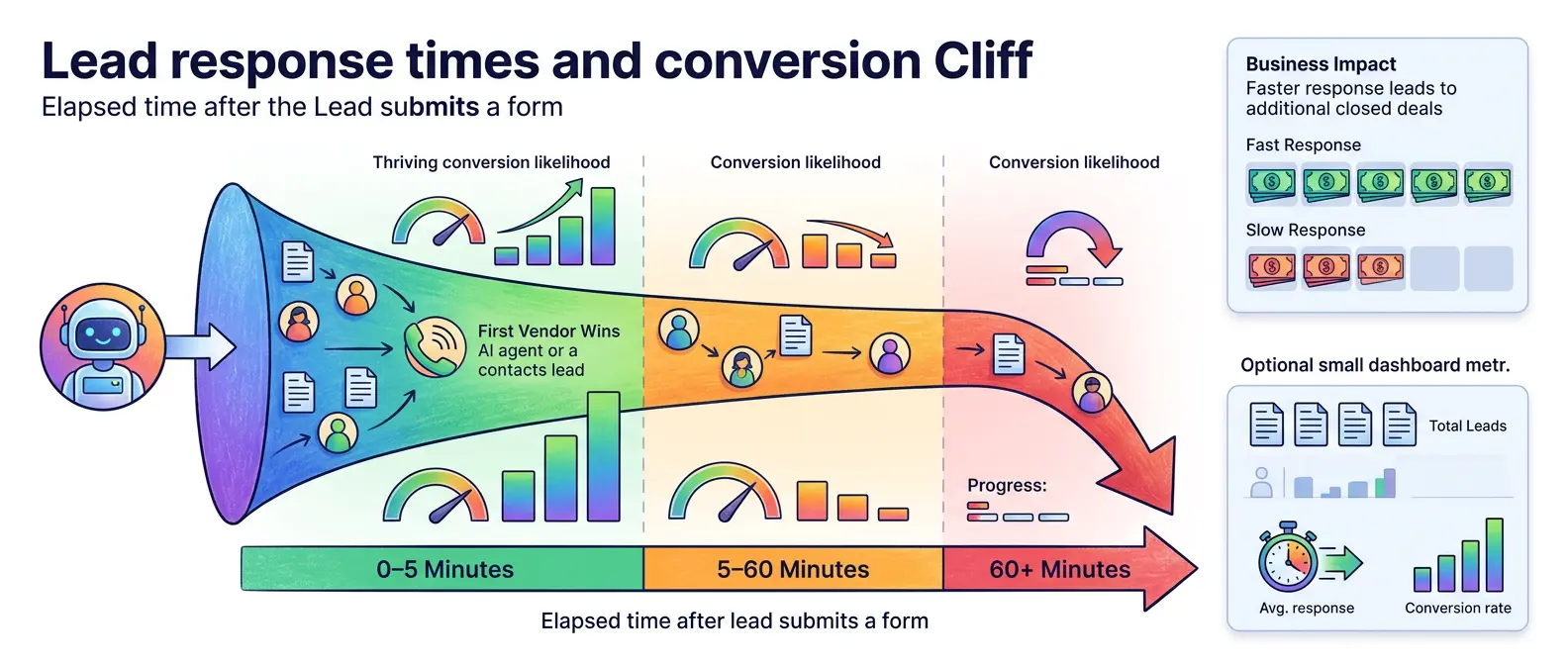
The 5-minute rule and why it exists
A lead contacted within 5 minutes is up to 100 times more likely to convert than one contacted after 10 minutes, because buying intent peaks at the moment of inquiry and decays fast. The 5-minute rule is the cheapest conversion lever a business has, and almost nobody meets it.
When a homeowner submits a lead form or calls a contractor, their intent is at its peak. They are actively comparing and ready to book. Within minutes, that intent decays as they move on to the next listing. The data is stark: a lead contacted within 5 minutes converts up to 100 times more often than one contacted after 10 minutes. Yet the average business takes 47 hours to respond, by which point the lead has already booked someone else. The 5-minute rule is not a benchmark; it is a cliff. This is the entire thesis of our speed to lead in 90 seconds guide: the first responder wins.
Why the average business fails the 5-minute rule
Most businesses fail the 5-minute rule because response depends on a human checking a form, returning a voicemail, or finishing a task. The fix is automation: instant text-back that engages the lead in under 15 seconds, guaranteeing the rule is met regardless of who is at the desk.
| Response method | Typical time | Conversion impact |
|---|---|---|
| Manual callback | Hours to days | Lead already gone, near-zero conversion |
| Voicemail return | Next business day | Lead cold, very low conversion |
| Auto email reply | Minutes | Low engagement, email often ignored |
| Instant text-back | Under 15 seconds | Intent caught, high conversion |
| AI qualification | Under 60 seconds | Lead qualified and booked instantly |
How automation collapses 47 hours into seconds
Instant text-back fires the moment a form is submitted or a call is missed, engaging the lead in under 15 seconds and keeping them warm while a human prepares. AI qualification then asks the right questions and can book the appointment directly, turning the 5-minute rule into a 15-second standard.
- Instant text-back fires on form submission or missed call, engaging in under 15 seconds.
- The text confirms receipt and asks a qualifying question to keep the lead engaged.
- AI qualification gathers the details a human would ask, without a human in the loop.
- Booking links let the lead self-schedule if no one is available to call back immediately.
- The CRM logs the entire exchange so the human follow-up has full context.
Building the instant-response flow is automation engineering, which is why an expert AI automation engineer architects the text-back, qualification, and booking logic so the 5-minute rule is a 15-second standard that runs inside an account you own. The contractor application is in missed-call text-back for contractors, and the dental application in missed-call text-back for dentists.
The cost of slow response, in dollars
Slow response is not just lost conversion; it is wasted ad spend. Every lead that goes cold because of a slow response is ad money spent with no return, and over a year that adds up to tens of thousands in wasted budget for a service business.
A contractor spending $3,000 a month on ads who responds in 47 hours instead of 5 minutes is wasting most of that budget, because the leads they paid for are booking with faster competitors. The math is in our how much missed calls cost business guide: the ad brought the lead, and the slow response threw it away. Speed is not a nice-to-have; it is the lever that determines whether ad spend produces revenue or evaporates.
The speed-to-lead checklist
Run this checklist: fire instant text-back on every form and missed call, qualify with AI in under a minute, offer self-scheduling for after-hours leads, log the exchange to the CRM, and measure response time weekly. Collapse 47 hours into 15 seconds and the conversion lift is automatic.
- 1Fire instant text-back on every form submission and missed call.
- 2Confirm receipt and ask a qualifying question to keep the lead engaged.
- 3Use AI qualification to gather details and book directly when no human is free.
- 4Offer self-scheduling links for after-hours leads so intent is captured.
- 5Measure average response time weekly and keep it under 5 minutes.
When you want the 5-minute rule automated into your CRM with instant text-back and AI qualification, book a free setup audit and we will show you the live system.
This is the core of the owned marketing engine model: every tool you currently rent, from the form to the text-back engine to the CRM, gets rebuilt as one system you own outright for a single one-time build fee.
Key takeaways
- A lead contacted within 5 minutes is up to 100x more likely to convert than after 10 minutes.
- The average business takes 47 hours to respond, by which point the lead is gone.
- Instant text-back collapses response time to under 15 seconds, guaranteeing the 5-minute rule.
- AI qualification books directly when no human is available, catching after-hours intent.
- Slow response is wasted ad spend; speed is the cheapest conversion lever a business has.

Marjohn Robillo— AI Automation Engineer & Lead AI Consultant
Marjohn Robillo is the AI Automation Engineer and Lead AI Consultant at Apehx Digital, architecting speed-to-lead, conversational text-back, and AI-qualification systems for US service businesses. Portfolio & consulting: marjohnrobillo.me.
See more of Marjohn's workFrequently Asked Questions
What is the 5-minute lead response rule?
The 5-minute rule states that a lead contacted within 5 minutes of their inquiry is up to 100 times more likely to convert than one contacted after 10 minutes. Speed is the strongest predictor of conversion because the lead's intent is highest at the moment of inquiry.
What is the average lead response time?
The average business takes 47 hours to respond to a new lead, which is why most leads go cold and convert with whoever responds first. Automation collapses that to seconds, which is where the conversion advantage is.
Why does speed to lead increase conversion?
Because the lead's buying intent peaks at the moment of inquiry and decays fast. A response in the first 5 minutes catches them while they are still actively searching and have not yet called a competitor.
How do I respond to leads in under 5 minutes?
With automated instant text-back that fires the moment a lead form is submitted or a call is missed, engaging the lead in under 15 seconds while a human prepares to follow up. The automation guarantees the 5-minute rule is never missed.
Does speed to lead matter for all industries?
Most for high-intent service businesses like contractors, dental, and med spa, where the lead is actively comparing and books with whoever responds first. The faster the buying intent decays, the more speed matters.
More from the blog
Related guides in the same topic cluster.